Elbert Terry: The Sunnyside American Dream
Duality
Houston’s historic neighborhood of Sunnyside is notorious for being high in crime and severely impoverished. This is not untrue as NeighborhoodScout.com did indeed rate Sunnyside as the 6th most dangerous American neighborhood.
Two things can be true: Sunnyside is a neighborhood filled with blight and dangerous activity but it’s also home to many working-class families. Many of those families are just as fed up with the crime as the average, law-abiding citizen.
There’s also the historical lens. Sunnyside, like Houston’s other historically-black neighborhoods, is where many Black families built their homes and livelihoods when success was a luxury not easily attainable for (or afforded to) them.
The Terry family was one of the many that created their own American dream in Sunnyside.

L-R: Redell Terry, James Arthur Terry Jr., Elbert Terry, Oranzo Terry, Dr. W. E. Terry, Alphonso Terry, Dr. Robert J. Terry
Foundation
Elbert Terry and his siblings, who are not all pictured above, were born to James Arthur Terry, Sr. (b. 1882) and Clara Terry (b. 1887). James Arthur Terry Sr. was a farmer and Clara was a housewife. Their residence at the time of the above photo was 3009 Beluah Street in what is today known as the South Side of Houston.
Below is a 2010 Google Street View of the home Mrs. Clara Terry and her sons are standing in front of. The home was demolished sometime in 2025. Both views are below:
Self-built
In February 1933, Elbert Terry and his wife, Girthia, moved into a home located at 4204 Stassen Street in Sunnyside. Mr. Terry built and developed their 4204 Stassen home along with several others in the neighborhood. He and his wife lived here and raised their two sons, Marvin (b. 1933) and Robert (b. 1936) in this home for over two decades.

Below: 2015 Google Map views of 4204 Stassen
Terry’s Grocery Market
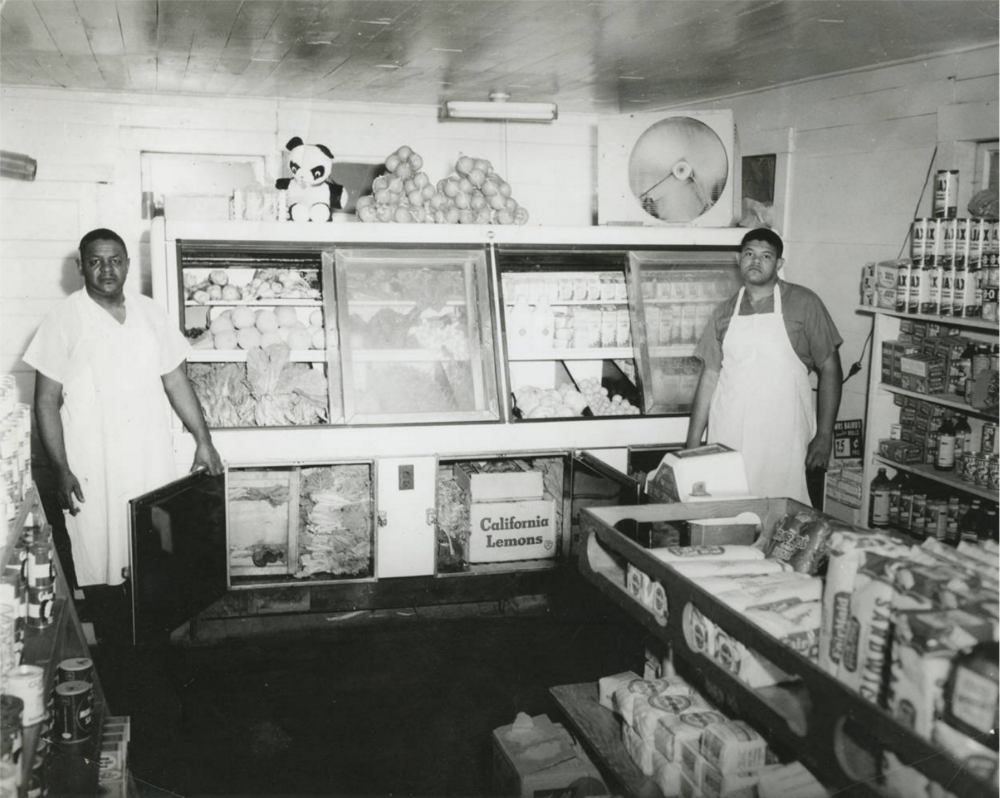
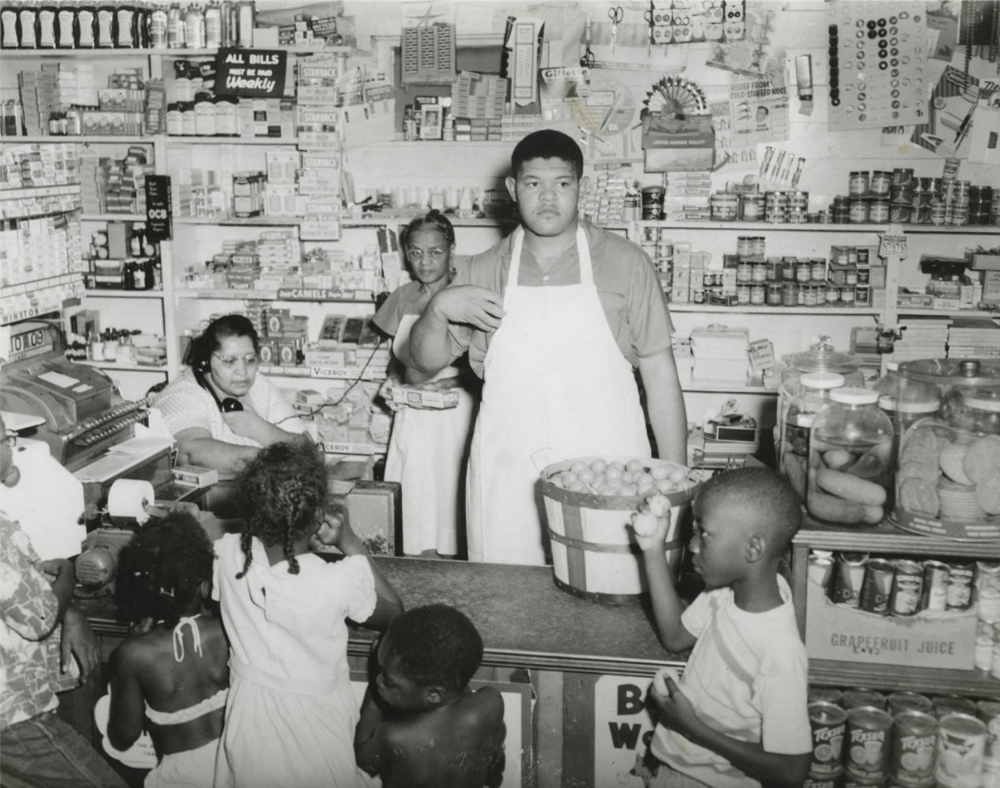
In addition to building his home, Elbert Terry built a grocery market at 4202 Stassen Street in the lot beside his home. He, his wife, and two sons managed and ran this store from atleast 1938 until well into the 1960s. Terry’s Grocery Market was very popular in Sunnyside and was originally one of only two stores in the neighborhood.
While I could not find a definite end date for Terry’s business, I did find out that grocery store was put up for sale in 1984.


Community and Service
Mr. Elbert Terry was dedicated to his community and, alongside managing his store, was heavily involved in the local church and government. Terry was a very active member of Pentecostal Missionary Baptist church, a civic leader in the NAACP, and the president of the Sunnyside Civic Club.

L to R: [unknown man], Elbert Terry, [unknown man], Houston Mayor Lewis Wesley Cutrer, City Councilman Lou Hassell
Elbert was successful in these many endeavors and in 1959 purchased a new home for his family at 4203 Rosemont Street. I’ve linked a Google street view of this still-standing home below.

Making History
I decided save the best for last and end our long list of Elbert Terry’s accomplishments with a bang. In July 1950, the Harris County Grand Jury announced that the August term would consist of more than one Black juror, for the first time since Reconstruction. In fact, it was going to have three, and Mr. Elbert Terry was one of them.


Elbert Terry is on the far left, Reverend W. H. Burks is standing in the center
Unfortunately, Mr. Elbert Terry died from lung cancer on July 4 1974, at the age of 64, a year after the above photo was taken. Elbert Terry accomplished plenty in his 64 years, and did it all in the face of adversity, resistance, and prejudice. He created a place, name, and legacy for himself in a world that had given him no room or means to do so. Like that of Reverend Jack Yates, Elbert Terry’s story is the pinnacle of the American Dream and what it meant for people of color.
Bonus Terry Family Greatness
The great-nephew of Elbert Terry reached out to me with some more information about Mr. Elbert’s siblings. I should have known that there was more to come from the Terry family name.
The youngest brother, Dr. Robert James Terry made several grand accomplishments of his own. A WWII Army veteran, he graduated from Texas Southern University (formerly, Houston’s College for Negroes) with a Bachelor’s in Biology. He then obtained his Master’s from Clark Atlanta University (formerly, Atlanta University) and his PhD from the University of Iowa.
He returned to Texas Southern University as a teacher in 1948, becoming a full-fledged professor in 1954. Excellence came naturally to Dr Robert J. Terry and he assumed the following roles at TSU:
- Head of the Biology Department (1958)
- Dean of The College of Arts and Sciences (1969 – 1971)
- Vice-President of Academic Affairs (1972 – 1982)
He eventually received the title of Distinguished Professor, the university’s highest rank for professors. With nowhere else to go but upwards, Mr. Robert James Terry was aptly named interim President of Texas Southern University in June 1986.
The title was made permanent later that same year and he was officially named the sixth president of TSU. Dr. Robert Terry held the position until his untimely death in 1987.
In addition to his many academic accolades in Houston, he severed on the research committee for the National Institute of of Health (NIH) and was an academic partner with India, performing guest lectures for universities within the country.